
GSSSB Staff Nurse(Ayurveda) : Becoming a Staff Nurse under Gujarat Subordinate Service Selection Board (GSSSB) requires a clear understanding of the syllabus and exam pattern. To excel in the recruitment process, candidates must be well-versed with the GSSSB Staff Nurse Syllabus 2026 and its structured exam format. The recruitment notification has already been released, making it crucial for aspirants to begin preparation early. This article provides a complete overview of the syllabus, exam pattern, and topic-wise weightage to help candidates plan their strategy effectively and maximize their scores for GSSSB Staff Nurse(Ayurveda).a
GSSSB Staff Nurse(Ayurveda) : The syllabus for the GSSSB Staff Nurse Exam 2026 is designed to evaluate both general aptitude and technical nursing knowledge. It is divided into two major parts: Part-A (General Studies) and Part-B (Technical Subjects). Candidates must prepare both sections thoroughly, as qualifying each part individually is mandatory.
Overview – GSSSB Staff Nurse(Ayurveda)
| GSSSB Staff Nurse Syllabus & Exam Pattern 2026 Overview | |
| Features | Details |
| Exam Name | GSSSB Staff Nurse Recruitment 2026 |
| Conducting Body | Gujarat Subordinate Service Selection Board |
| Post Name | Staff Nurse (Ayurveda), Class-III |
| Total Vacancies | 90 |
| Exam Mode | CBRT (Computer Based Response Test) or OMR (Optical Mark Recognition) |
| Total Questions | 210 Questions |
| Total Marks | 210 Marks |
| Total Duration | 3 Hours (180 Minutes) |
| Marking Scheme | 1 Mark per correct answer |
| Negative Marking | 1/4 (0.25) marks deducted for each wrong answer |
| Qualifying Marks | Minimum 40% in Part-A AND Minimum 40% in Part-B |
| Selection Process | Written Exam, Document Verification |
GSSSB Staff Nurse(Ayurveda) Syllabus 2026
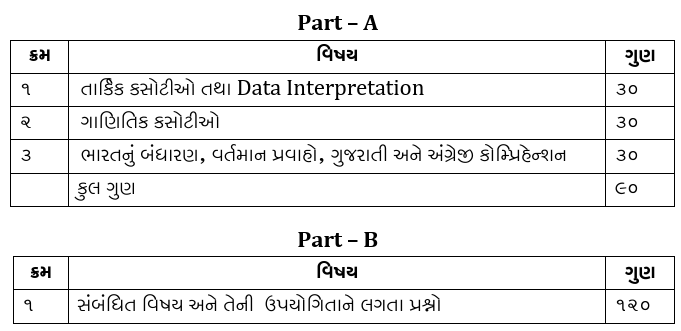
Part-A: General Studies – GSSSB Staff Nurse(Ayurveda)
Part-A focuses on assessing candidates’ general awareness, reasoning ability, and quantitative skills. This section is crucial for building a strong foundation and improving overall score accuracy.
Reasoning & Data Interpretation (30 Marks)
- Problems on Ages
- Venn Diagrams
- Visual Reasoning
- Blood Relations
- Arithmetic Reasoning
- Data Interpretation (Charts/Graphs)
- Data Sufficiency
Quantitative Aptitude (30 Marks)
Number Systems
Simplification
Algebra Arithmetic
Progressions
Geometric Progressions
Average Percentage
Profit & Loss
Ratio & Proportion
Partnership
Time & Work
Speed & Distance
Chain Rule
Constitution of India (10 Marks)
- Preamble
- Fundamental Rights
- Fundamental Duties
- Directive Principles of State Policy
- Powers of President
- Powers of Governor
- Parliamentary System
- Constitutional Amendments
- Emergency Provisions
- Judicial System
Current Affairs (10 Marks)
Regional Events
National Events
International Events of Importance
Comprehension (10 Marks)
- Gujarati Language (5 Marks)
- English Language (5 Marks)
- Interpretation & Inference-Based Questions (Paragraphs/Assertion Type)
Part-B: Technical Qualification (120 Marks) – GSSSB Staff Nurse(Ayurveda)
This section focuses on subjects related to Ayurveda and General Nursing. Here’s the detailed subject-wise syllabus:
1. Ayurveda & General Nursing (25 Marks)
- Introduction to eight branches of Ayurveda (Kaya, Bala, etc.)
- History of Ayurveda
- Nursing principles
- Nursing ethics
- Hospital management (NABH)
2. Anatomy & Physiology (05 Marks)
- Six limbs of the body
- Cells and tissues
- Bones
- Srotas (body channels)
- Dosha-Dhatu-Mala functions
- Digestive system
- Circulatory system
3. Dravyaguna, Rasashastra & Bhaishajya Kalpana (10 Marks)
- Medicinal properties of herbs (Triphala, Ashwagandha, etc.)
- Processing methods (Shodhana, Marana)
- Preparation of Ayurvedic medicines
4. Obstetrics, Gynecology & Pediatrics (20 Marks)
- Female reproductive system
- Antenatal care
- Postpartum care
- Common gynecological diseases
- Child health care (Kaumarabhritya)
- Vaccinations
5. Diagnosis & Kayachikitsa (10 Marks)
- Disease symptoms
- Treatment pillars (Chatushpada)
- Disorders of various Srotas (respiratory, digestive, mental)
- Therapies
6. Panchakarma & Nursing (20 Marks)
- Vamana
- Virechana
- Basti
- Nasya
- Raktamokshana
- Kerala Panchakarma procedures
- Nursing roles in Panchakarma
7. Shalya – Shalakya (10 Marks)
- Surgical procedures (Agnikarma, Ksharakarma)
- Wound management
- Fractures
- Diseases of Eye, Ear, Nose, and Throat
8. Swasthavritta, Yoga & Naturopathy (20 Marks)
- Personal health
- Community health
- Yoga asanas
- Pranayama
- Hospital admission procedures
- Discharge procedures
- National health programs
GSSSB Staff Nurse(Ayurveda) Exam Pattern 2026

| GSSSB Staff Nurse (Ayurveda) Syllabus PDF [Page No.19 to 28] | Download PDF |
| GSSSB Official Website | Click Here |
| More Information | Click Here |
Candidates must understand the exam structure to perform well. The GSSSB Staff Nurse exam is conducted as a single-stage competitive test with objective-type questions. The detailed pattern is given below.
- Total Duration: 180 minutes (3 hours)
- Question Type: Multiple Choice Questions (MCQs)
- Negative Marking: 0.25 marks deducted for each wrong answer
- Qualifying Marks: Minimum 40% in Part-A and 40% in Part-B separately Part-A questions on Constitution and Current Affairs will be available in Gujarati and English.
- Comprehension will be in the respective language.
- Part-B technical questions will also be in Gujarati and English.
- In case of discrepancies, the English version will be considered final.
GSSSB Staff Nurse (Ayurveda) Exam Pattern 2026
| Part | Section | Language | Questions | Marks |
| Part-A | General Studies | Gujarati and English (Except Comprehension) | 90 | 90 |
| Part-B | Technical Subjects | Gujarati and English | 120 | 120 |
| Total | 210 | 210 |
FAQs
What is the exam pattern for GSSSB Staff Nurse 2026?
The exam consists of 210 multiple-choice questions for 210 marks, conducted in 3 hours, with 0.25 negative marking for each wrong answer.
How is the GSSSB Staff Nurse syllabus structured?
The syllabus is divided into two parts: Part-A (General Studies – 90 marks) and Part-B (Technical Subjects – 120 marks).
What subjects are included in Part-A of the syllabus?
Part-A includes Reasoning, Quantitative Aptitude, Constitution of India, Current Affairs, and Comprehension (Gujarati & English).
What topics are covered under the technical section (Part-B)?
Part-B includes Ayurveda & Nursing, Anatomy, Dravyaguna, Obstetrics, Panchakarma, Shalya-Shalakya, and Yoga & Naturopathy.
Table of Contents